
Is this your Vital listing? Go Pro to claim it so you can keep your links and info up to date, get highlighted in the directory with upgraded card styling, and pick up better SEO so more Vital users can find you!
Echo Sound Works is dedicated to making high quality content for aspiring music producers, mixing engineers, songwriters, artists, and DJ's.
Is this your Vital listing? Go Pro to claim it so you can keep your links and info up to date, get highlighted in the directory with upgraded card styling, and pick up better SEO so more Vital users can find you!
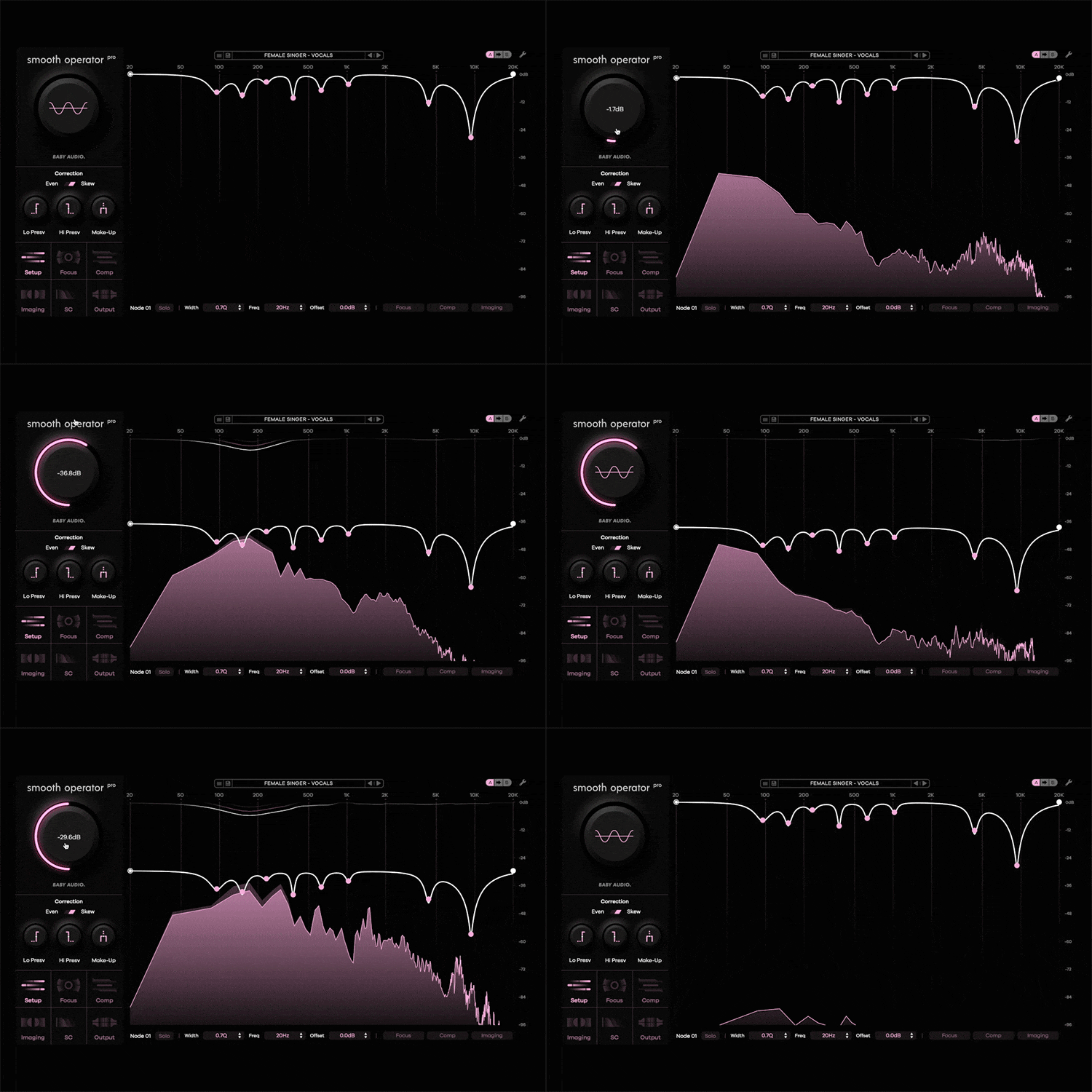
Vital can generate huge, complex sounds—but that also means mud, harshness, and masking can build up fast. Smooth Operator Pro is a dynamic spectral balancer that automatically cleans up bloated frequencies, tames resonances, and opens up space so your pads, leads, and basses sit perfectly in any mix. Turn one global control to “lift the blanket off your speakers,” or dive deeper with per‑band tweaks when you need surgical control.
If you use Vital a lot, this page is here to help you decide faster. We hand‑pick creators and products that actually add something useful to your Vital workflow—whether that’s presets, skins, wavetables, or learning resources.
Not every pack or profile on the internet makes the cut. Listings here are chosen on purpose for sound quality, usefulness, and clear info, so you can quickly tell if this is a good fit for how you make music.
Join us! Got a Vital skin, preset pack, wavetable collection, or tutorial you’re proud of? Submit your offer and we’ll take a look for inclusion in the directory.
There is a strict hierarchy: > Direct Registry Editing . If you configure the licensing mode via gpedit.msc (Computer Config > Admin Templates > Windows Components > Remote Desktop Services > Licensing), those settings are written to the Policy Store key ( HKLM\SOFTWARE\Policies ). Once that policy is set, any changes you make to the Licensing Core key will be overwritten or ignored.
After making registry changes, use the tool to confirm the server status.
are used to configure the licensing mode, specify license servers, or reset the 120-day grace period. 1. Configuring Licensing Mode & Servers
Instead of manually editing SpecifiedLicenseServers , set the policy “Use the specified license servers” via GPO. Registry edits should only be temporary.
HKEY_LOCAL_MACHINE\SYSTEM\CurrentControlSet\Control\Terminal Server\Licensing Core Use code with caution.
RDS CAL License Registry Key — Detailed Review and Guidance
Managing RDS Client Access Licenses (CALs) via the registry is often necessary when Group Policy or the Server Manager GUI fails to apply settings correctly. You can configure the licensing mode and the license server address directly through the Registry Editor. 1. Configure the RDS Licensing Mode
If you need to find where the actual licensing server stores its database configuration and activated license packs, navigate to:
Right-click the key and select Export to create a backup file (.reg). Right-click the MSLicensing key again and select Delete .
Inside the key, locate the binary value (usually named with a long GUID string like L$RTMTIMEBOM... ). Right-click the binary value and select . Reboot the Remote Desktop Session Host server.
HKEY_LOCAL_MACHINE\SYSTEM\CurrentControlSet\Control\Terminal Server\RCM\Licensing Core Use code with caution.
On the RDS server itself, the registry is where administrators can verify and force critical operational states when the GUI tools are unresponsive.
Upon reboot, Windows regenerates the key and resets the 120-day countdown. 3. Fixing Client-Side Licensing Errors via Registry
Get an email when we add new Vital preset packs, skins, or wavetables, plus occasional heads‑up on solid limited‑time discounts.
The form has been successfully submitted.
We will review your software soon!
See you soon.
There is a strict hierarchy: > Direct Registry Editing . If you configure the licensing mode via gpedit.msc (Computer Config > Admin Templates > Windows Components > Remote Desktop Services > Licensing), those settings are written to the Policy Store key ( HKLM\SOFTWARE\Policies ). Once that policy is set, any changes you make to the Licensing Core key will be overwritten or ignored.
After making registry changes, use the tool to confirm the server status.
are used to configure the licensing mode, specify license servers, or reset the 120-day grace period. 1. Configuring Licensing Mode & Servers
Instead of manually editing SpecifiedLicenseServers , set the policy “Use the specified license servers” via GPO. Registry edits should only be temporary. rds cal license registry key
HKEY_LOCAL_MACHINE\SYSTEM\CurrentControlSet\Control\Terminal Server\Licensing Core Use code with caution.
RDS CAL License Registry Key — Detailed Review and Guidance
Managing RDS Client Access Licenses (CALs) via the registry is often necessary when Group Policy or the Server Manager GUI fails to apply settings correctly. You can configure the licensing mode and the license server address directly through the Registry Editor. 1. Configure the RDS Licensing Mode There is a strict hierarchy: > Direct Registry Editing
If you need to find where the actual licensing server stores its database configuration and activated license packs, navigate to:
Right-click the key and select Export to create a backup file (.reg). Right-click the MSLicensing key again and select Delete .
Inside the key, locate the binary value (usually named with a long GUID string like L$RTMTIMEBOM... ). Right-click the binary value and select . Reboot the Remote Desktop Session Host server. After making registry changes, use the tool to
HKEY_LOCAL_MACHINE\SYSTEM\CurrentControlSet\Control\Terminal Server\RCM\Licensing Core Use code with caution.
On the RDS server itself, the registry is where administrators can verify and force critical operational states when the GUI tools are unresponsive.
Upon reboot, Windows regenerates the key and resets the 120-day countdown. 3. Fixing Client-Side Licensing Errors via Registry