
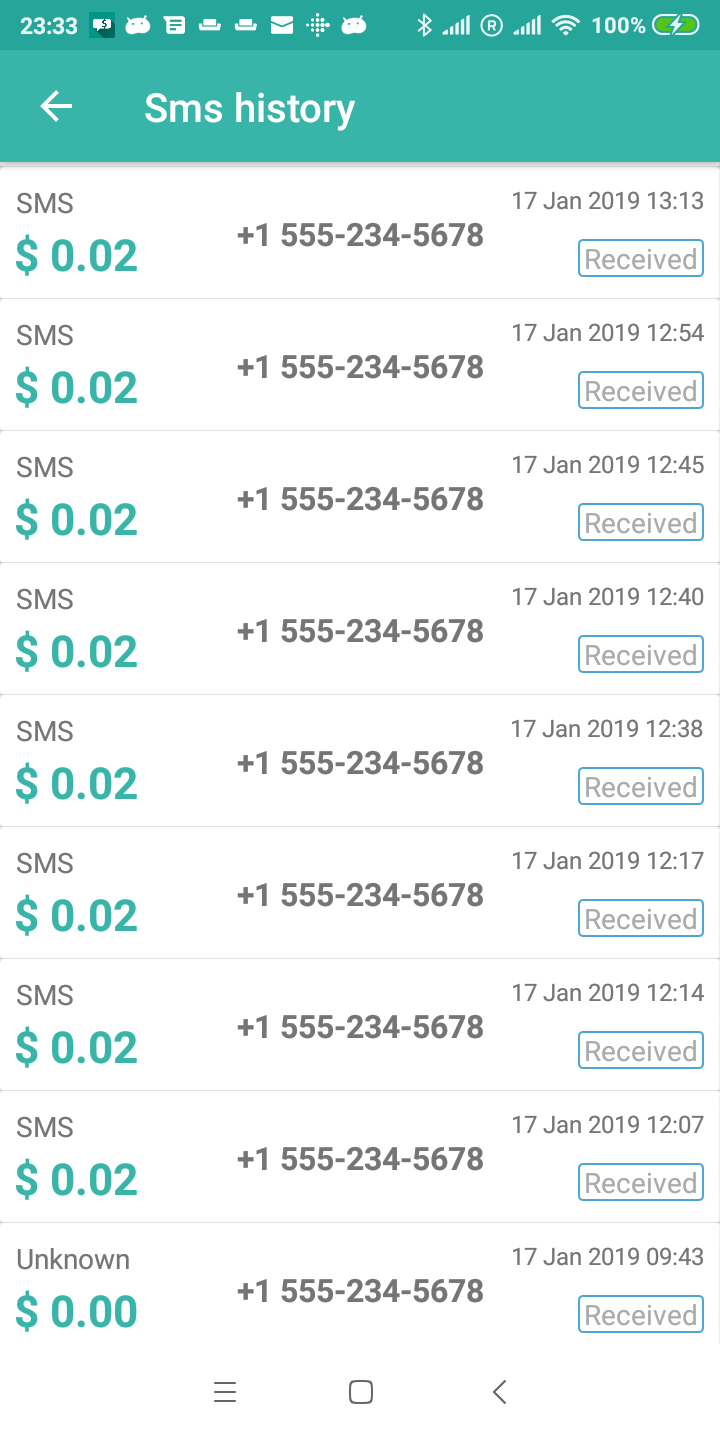
All you have to do is run the SMS Profit app and allow us to send you SMS. Everything works in the background so you can earn real money online for doing nothing.
More registered numbers, more money! Earn for every SMS
test received.
Contact us for custom deal!
By using our app, you help us to improve the quality of SMS delivery. In return, you will be rewarded for each SMS you receive.
Read more

Just run the app, make sure your phone is always connected to the internet and get paid for SMS you receive for any phone number you verify. With SMP Profit you don’t need to do anything else to make money.
Withdraw money from the app to the wallet of one of the world’s most popular payment systems.


All you need to sign up is an email address and at least one
phone number. You can register more than one device and more
than one phone number on the same account if you want to earn
more and faster!
[Note: Use the same email account, if you often change email
accounts with the same phone numbers, our system could
automatically block your account or phone number!](note: Use
the same email account, if you often change email accounts
with the same phone numbers, our system could automatically
block your account or phone number!)
You don’t need to invest anything, in fact you will be rewarded with $0.5 for your registration.

From the tragedy of J.C. Daniel and P.K. Rosy to the global triumph of contemporary Malayalam cinema, the journey has been extraordinary. An industry that began with a Dalit woman driven into exile is now producing work that speaks to audiences across languages, continents, and cultures. The tea glass clinking against a saucer, the moss growing on a compound wall, the silence that becomes a scene—these small, intimate details have become Kerala's most powerful export. The secret is not just out. It is conquering the world, one subtle frame at a time.
Yet, this was also the moment a distinctive identity began to form. The early Malayalam film world pivoted in a starkly different direction from the mainstream: it embraced . Landmark films like Balan (1938), the first talkie, were followed by Neelakuyil in 1954, a film that boldly tackled caste oppression and anchored itself firmly in Kerala's lived realities rather than mythological fantasies. Neelakuyil would win the President's Silver Medal, establishing a tradition of socially conscious storytelling that would become the industry's signature. hot mallu aunty sex videos updated download
This public link is valid for 7 days and shares a thread, including any personal information you added. This link or copies made by others cannot be deleted. If you share with third parties, their policies apply. Can’t copy the link right now. Try again later. From the tragedy of J
As scholar Meena T. Pillai has documented, Malayalam cinema's treatment of caste and gender has evolved from oppressive stereotyping to increasing complexity—though the journey is far from complete. An industry that began with a Dalit woman
The transition to talkies brought a wave of films heavily influenced by Malayalam literature and theater. The 1950s and 1960s marked a golden age of literary adaptations. Masterpieces like Neelakuyil (1954), co-directed by P. Bhaskaran and Ramu Kariat, directly addressed untouchability and feudal oppression. Chemmeen (1965), based on Thakazhi Sivasankara Pillai's classic novel, won the National Film Award for Best Feature Film, bringing global attention to the industry. These films were not mere entertainment; they were instruments of social critique, mirroring the communist and progressive reformist movements sweeping through Kerala. The Mirror of Kerala's Unique Socio-Political Landscape


From the tragedy of J.C. Daniel and P.K. Rosy to the global triumph of contemporary Malayalam cinema, the journey has been extraordinary. An industry that began with a Dalit woman driven into exile is now producing work that speaks to audiences across languages, continents, and cultures. The tea glass clinking against a saucer, the moss growing on a compound wall, the silence that becomes a scene—these small, intimate details have become Kerala's most powerful export. The secret is not just out. It is conquering the world, one subtle frame at a time.
Yet, this was also the moment a distinctive identity began to form. The early Malayalam film world pivoted in a starkly different direction from the mainstream: it embraced . Landmark films like Balan (1938), the first talkie, were followed by Neelakuyil in 1954, a film that boldly tackled caste oppression and anchored itself firmly in Kerala's lived realities rather than mythological fantasies. Neelakuyil would win the President's Silver Medal, establishing a tradition of socially conscious storytelling that would become the industry's signature.
This public link is valid for 7 days and shares a thread, including any personal information you added. This link or copies made by others cannot be deleted. If you share with third parties, their policies apply. Can’t copy the link right now. Try again later.
As scholar Meena T. Pillai has documented, Malayalam cinema's treatment of caste and gender has evolved from oppressive stereotyping to increasing complexity—though the journey is far from complete.
The transition to talkies brought a wave of films heavily influenced by Malayalam literature and theater. The 1950s and 1960s marked a golden age of literary adaptations. Masterpieces like Neelakuyil (1954), co-directed by P. Bhaskaran and Ramu Kariat, directly addressed untouchability and feudal oppression. Chemmeen (1965), based on Thakazhi Sivasankara Pillai's classic novel, won the National Film Award for Best Feature Film, bringing global attention to the industry. These films were not mere entertainment; they were instruments of social critique, mirroring the communist and progressive reformist movements sweeping through Kerala. The Mirror of Kerala's Unique Socio-Political Landscape
Try it now at
*Works on Android 5.1 and above.
